Introduction
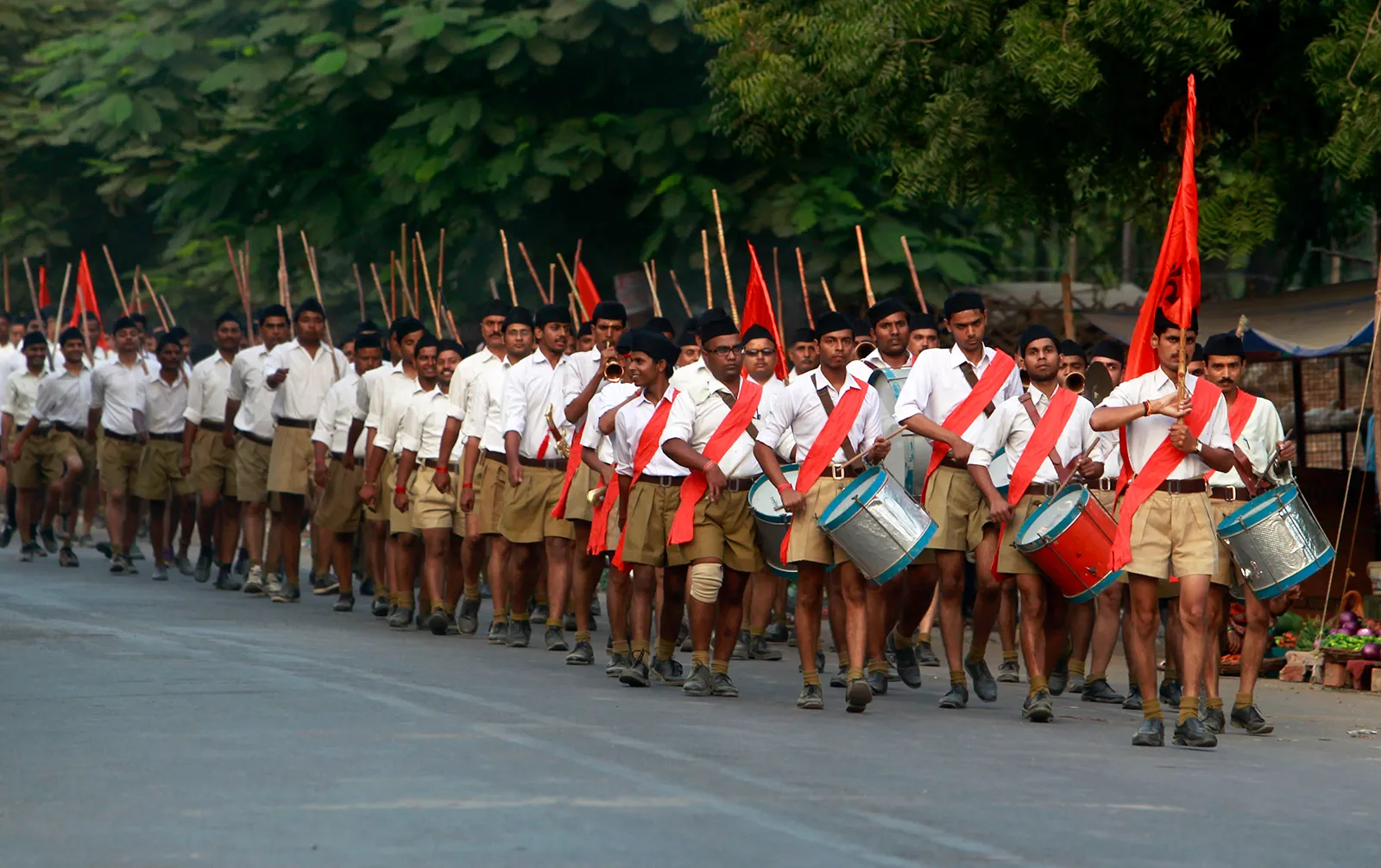
The Rashtriya Swayamsevak Sangh (RSS), founded in 1925, has long positioned itself as a defender of the nation and Hindu interests. However, a critical examination of historical evidence, organizational documents, and speeches by RSS leaders reveals a deeply troubling record that fundamentally challenges India’s constitutional values of secularism, pluralism, and national unity. This article presents documented evidence demonstrating how the RSS ideology and activities have consistently threatened the fabric of Indian democracy and territorial integrity.
Rejection of india’s Constitutional Framework
From its inception, the RSS has opposed the foundational principles enshrined in India’s Constitution. When the Constituent Assembly adopted the Constitution on November 30, 1949, the RSS organ Organizer openly denounced it, lamenting that “in our constitution, there is no mention of that unique constitutional development in ancient Bharat”—referring to the Manusmriti. The RSS wanted India’s Constitution replaced by the Manusmriti, a text notorious for its derogatory treatment of Shudras, untouchables, and women.
MS Golwalkar, the second and most influential RSS chief, dismissed the Constitution as “just a cumbersome and heterogeneous piecing together of various articles from various Constitutions of Western countries” with “absolutely nothing, which can be called our own”. In his seminal work Bunch of Thoughts, considered the ideological bible of the RSS, Golwalkar declared the Constitution fundamentally flawed because it failed to establish Hindu supremacy.
The RSS’s rejection of constitutional values extends to the national flag itself. In an editorial titled “The Nation’s Flag” published in Organizer on July 17, 1947, the RSS denounced the Tricolor, stating it would “never be respected and owned by the Hindus” and that “a flag having three colors will certainly produce a very bad psychological effect and is injurious to a country”. Golwalkar criticized the Tricolor as “communal” and argued that “the word three is in itself an evil”. The RSS did not officially hoist the national flag at its headquarters until 2002, when compelled by a court order.
Ideological Foundations: Exclusion and Nazi Inspiration
The ideological core of the RSS, as articulated by Golwalkar in his 1939 book We, or Our Nationhood Defined, presents an openly exclusionary vision that drew explicit inspiration from Nazi Germany. Golwalkar wrote approvingly: “To keep up the purity of the Race and its culture, Germany shocked the world by her purging the country of the Semitic Races—the Jews. Race pride at its highest has been manifested here”.
This was not merely theoretical admiration. Golwalkar prescribed a similar solution for India’s minorities: “The foreign races in Hindustan must either adopt the Hindu culture and language, must learn to respect and hold in reverence Hindu religion, must entertain no idea but those of the glorification of the Hindu race and culture… or may stay in the country, wholly subordinated to the Hindu Nation, claiming nothing, deserving no privileges, far less any preferential treatment—not even citizen’s rights”.
In Golwalkar’s worldview, Muslims and Christians were “foreign elements” and “invaders,” while only Hindus constituted the true nation. He characterized Muslims as perpetual threats, claiming in 1960 that “right from Delhi to Rampur, Muslims are busy hatching a dangerous plot, piling up arms and mobilizing their men”. Such rhetoric, devoid of evidence yet delivered by the RSS’s supreme leader, served to demonize an entire community and fuel communal hatred.
Opposition to federalism and democratic Principles
Contrary to recent attempts at historical revisionism, the RSS played no significant role in India’s independence movement. As an organization, the RSS did not participate in any anti-British movement from 1925 to 1947. While individual members may have held nationalist sentiments, the organizational leadership actively discouraged involvement in the freedom struggle.
Golwalkar explicitly denounced the freedom movement as “territorial nationalism” that had “deprived us of the positive and inspiring content of our real Hindu Nationhood and made many of the ‘freedom movements’ virtually anti-British movements”. The RSS kept aloof because the inclusive nationalism of the Congress contradicted its exclusivist Hindu Rashtra vision.
During the Quit India Movement of 1942, the RSS remained conspicuously absent. British government documents acknowledged that “the Sangh has scrupulously kept itself within the law, and in particular, has refrained from taking part in the disturbances that broke out in August 1942”. RSS leaders even met with British authorities, promising to encourage members to join civic guards formed to suppress the independence movement.
VD Savarkar, the ideological mentor of the RSS and president of the Hindu Mahasabha, actively collaborated with the British during World War II. He appealed to Hindus to “participate in all war-efforts of the British Government” and ran coalition governments with the Muslim League in Bengal, Sindh, and the North-West Frontier Province even as Congress leaders languished in British jails. Syama Prasad Mookerjee, Savarkar’s deputy and later founder of the Bharatiya Jana Sangh (RSS’s political wing), assured the British that both the Hindu Mahasabha and Muslim League saw Congress as their “main enemy”.
Gandhi’s Assassination and the ban on rss
The clearest manifestation of the RSS’s dangerous ideology came with the assassination of Mahatma Gandhi on January 30, 1948. While Nathuram Godse, Gandhi’s assassin, claimed to have left the RSS, evidence suggests his deep involvement with RSS ideology and personnel throughout his life. In his court statement defending the murder, Godse echoed core RSS positions, particularly hatred of Gandhi’s inclusive approach toward Muslims.
Sardar Vallabhbhai Patel, India’s first Home Minister, wrote to Golwalkar on September 11, 1948, stating unequivocally: “The activities of the RSS constituted a clear threat to the existence of Government and the State… as time has marched on, the RSS circles are becoming more defiant and are indulging in their subversive activities in an increasing measure”. Patel identified the RSS’s role in creating the atmosphere that made Gandhi’s assassination possible, noting that “the extreme section of the Hindu Mahasabha was involved in this conspiracy” and that RSS activities posed ongoing threats.
The government banned the RSS on February 4, 1948, citing that “individual members of Rashtriya Swayamsevak Sangh have indulged in acts of violence involving arson, robbery, dacoity, and murder and have collected illicit arms and ammunition”. RSS members “expressed joy and distributed sweets after Gandhiji’s death,” further revealing their anti-national character.
Role in communal violance: a consistant pattern
The RSS and its affiliates—Vishwa Hindu Parishad (VHP), Bajrang Dal, and others—have been repeatedly implicated in communal violence targeting minorities across India. This pattern spans decades and continues to the present.
1969 Ahmedabad Riots: The Justice P. Jaganmohan Reddy Commission found that “handbills calling for a religious war were distributed to the rioters by the Jan Sangh and the RSS”.
1978 Aligarh Riots: The People’s Union for Civil Liberties blamed “RSS-Jan Sangh and more significantly, on the differences and jockeying for power among local politicians” for riots that killed over 30 people, mostly Muslims. The Provincial Armed Constabulary “betrayed an unmistakably Hindu communal bias by shooting innocent Muslims”.
1979 Jamshedpur Riots: The Justice Jitendra Narain Commission concluded that “the RSS, with its extensive organization in Jamshedpur and close links with the Janata Party and the BMS, had a hand in creating a climate propitious for the outbreak of these disturbances”. Not a single Hindu was killed by police firing during 22 hours of action to quell the riots.
1992 Babri Masjid Demolition: On December 6, 1992, a mob of 150,000 RSS, VHP, and BJP supporters demolished the 400-year-old Babri Masjid in Ayodhya. This act of violence triggered riots across South Asia that killed over 2,000 people, mainly Muslims. Intelligence reports revealed that “the Bajrang Dal and Shiv Sena were vying with each other for the ‘fame’ of blowing up the disputed structure”. The demolition was not spontaneous but meticulously planned by RSS leadership, as documented in the Liberhan Commission report.
2002 Gujarat Pogrom: The anti-Muslim violence in Gujarat killed at least 1,000 people, with most victims being Muslims. The RSS, VHP, and Bajrang Dal incited genocidal massacres following the Godhra train burning. Then-Chief Minister Narendra Modi, a lifelong RSS member, was accused of deliberately allowing the violence. Senior police officer Sanjiv Bhatt testified that Modi told officials “the Muslim community needed to be taught a lesson”. The violence included systematic rape, murder, and property destruction aimed at “purging Muslims from Hindu areas”.
2008 Kandhamal Violence: Violence against Christians in Odisha’s Kandhamal district, led by the Bajrang Dal, RSS, and VHP, killed between 39 and 500 Christians and displaced over 50,000 people. The National Commission for Minorities blamed “Sangh Parivar outfits and the Bajrang Dal” for the violence. VHP leader Pravin Togadia traveled across the state inciting violence, and thousands of Christians were forced to convert to Hinduism under threat of death.
2013 Muzaffarnagar Riots: BJP leaders gave “incendiary speeches instigating Hindu farmers” at a mahapanchayat on August 31, 2013. The subsequent violence killed 62 people (42 Muslims, 18 Hindu Jats) and displaced over 50,000 Muslims. The Justice Vishnu Sahai Commission blamed members of both the Samajwadi Party and BJP for involvement in the violence.
2020 Delhi Riots: Following BJP leader Kapil Mishra’s inflammatory speech threatening anti-CAA protesters, riots erupted that killed 53 people, most of them Muslims. The violence occurred during US President Trump’s visit to India and targeted peaceful protesters against the discriminatory Citizenship Amendment Act. Despite widespread evidence of instigation by BJP-RSS leaders, Delhi Police instead arrested student activists and anti-CAA protesters on conspiracy charges.
Contemporary threat and hate speech
The pattern of RSS-affiliated organizations inciting violence continues unabated. RSS leaders regularly deliver hate speeches targeting minorities with impunity.
In October 2024, RSS leader Kalladka Prabhakar Bhat was booked for hate speech at a Deepotsava event where he made inflammatory remarks about Muslim reproductive practices, stating: “In one house, there was a woman who already had six children and was pregnant with the seventh. Did anyone question her? No one dares. They say it’s for Allah”. Such speeches deliberately stoke communal hatred and reinforce the RSS narrative of Muslims as demographic threats.
The Bajrang Dal openly threatens minorities. In December 2020, Bajrang Dal leader Mithu Nath threatened to beat Hindus for visiting churches in Assam. Members have been involved in violent attacks on interfaith couples under the guise of opposing “Love Jihad,” mob lynchings over beef consumption, and assaults on Christians celebrating their faith.
Hindu extremist organizations, with RSS backing, have increasingly called for Muslim boycotts. In Haryana in 2023, Bajrang Dal members moved through towns with microphones, threatening shopkeepers who employed Muslims: “If in two days, a Muslim vendor is still there, he will be solely responsible for what happens to him”. Such open threats demonstrate the institutionalized nature of anti-minority violence
The Threat to national unity
Ideological Exclusion: By defining Indian nationality exclusively in Hindu terms, the RSS creates a hierarchy of citizenship that alienates 200 million Muslims, 28 million Christians, and other minorities. This divisive ideology directly contradicts the constitutional promise of equality. Communal Violence: The documented pattern of RSS-affiliated organizations inciting and participating in riots has killed thousands and displaced hundreds of thousands. This violence traumatizes communities, creates lasting divisions, and undermines social cohesion. Constitutional Subversion: The RSS’s opposition to federalism, secularism, democracy, and minority rights attacks the Constitution’s basic structure. Its demand for a unitary state threatens the federal arrangement that holds India’s diverse states together.
Historical Revisionism: Attempts to portray the RSS as nationalist despite its collaboration with the British and opposition to the freedom movement distort history and dishonor genuine freedom fighters.
Democratic Backsliding: With RSS members now holding positions of power, including the Prime Minister’s office, the organization’s authoritarian tendencies manifest in attacks on dissent, media freedom, and judicial independence. The evidence demonstrates that the RSS’s ideology, rooted in exclusionary Hindu nationalism inspired by fascist movements, fundamentally contradicts the inclusive, pluralistic vision that India’s founders enshrined in the Constitution. From rejecting the national flag and Constitution to inciting communal violence, from collaborating with colonial rulers to assassinating Gandhi, from opposing federalism to demanding Hindu supremacy—the RSS has consistently worked against India’s territorial integrity, social harmony, and democratic values.
As Sardar Patel warned in 1948, the RSS constitutes “a clear threat to the existence of Government and the State”. That assessment, grounded in historical evidence and the organization’s own documents, remains tragically relevant. India’s unity and integrity depend on upholding constitutional values of secularism, equality, and pluralism—values the RSS has opposed since its inception and continues to undermine today.